
The Dead Zone

We’re still in that Dead Zone between Thanksgiving and the first week of the New Year where nothing much happens, although I’m still sending out queries and the occasional pass does still hit my inbox.
It’s given me some time to think, though, about how I want to tackle the coming year. Things are different now. The company I work for was just swallowed up by a bigger company with lots of changes coming, I have a young child in my life to care for, priorities are shifting and the amount of time I can dedicate to my writing career has new limits.
So the questions are:
Am I going to write anything new in 2026? Probably, although I don’t have anything in mind. I’ve already written a lifetime worth of material, though not all of it is necessarily evergreen. I think at the beginning of the year at least, with my limited time and resources, I’ll probably focus on marketing, although inspiration may strike.
Am I going to seriously consider self-publishing in 2026? Not right away, I don’t think. I still have a lot of potential agents and publishers to go through. If I’m not seeing progress by next fall though, I have a feeling this idea will become much closer to reality. A lot can happen between now and then, though. Hopefully I won’t have to.
What about my screenwriting/TV writing career? I moved to novel writing because I grew frustrated with the Hollywood game, but I still love my scripts and writing screenplays. I don’t think I’ll ever give up on trying to find a home for them, but given how tough the market is, and how most of my efforts would require investing more of my limited financial resources in one way or another (e.g. Contest entries, paid pitchfests/conferences, consultation fees), I don’t think it can be a priority unless a great opportunity presents itself, which, sometimes they do.
I suppose the good thing about a new year is that, even though it’s really an arbitrary date, it does feel like there’s a clean slate with new possibilities. Hopefully we’ll discover them together.
Last time I showed you an excerpt of the book’s narrative, what follows is one of the “dossier entries,” part of the appendix which features the “real” Monstra Genera, or Book of Monsters. Enjoy.
Weekly Tab: 4 queries 1 Pass
Class: Minisculae
Type: Gremlin
Known Locations: United Kingdom
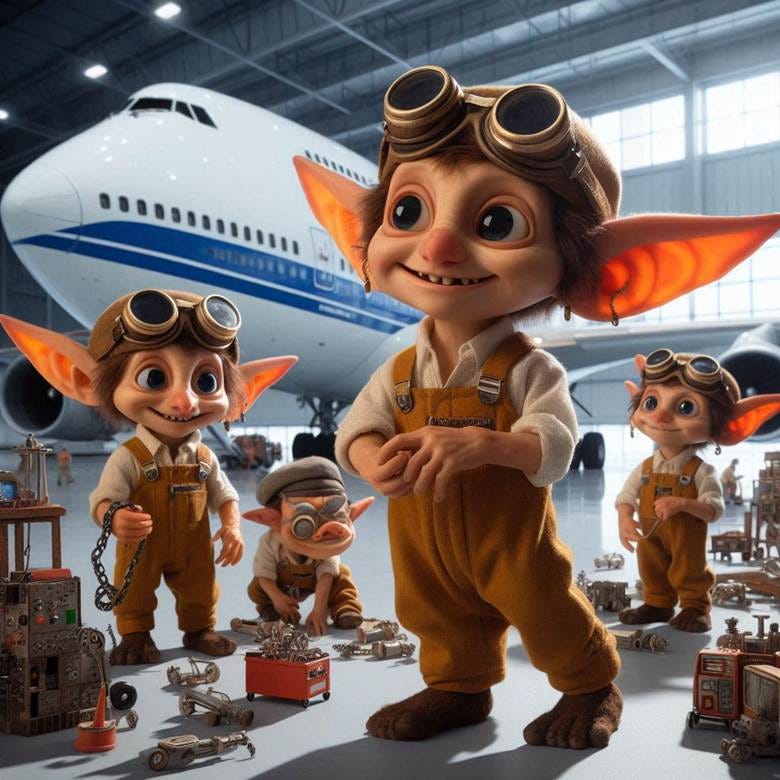
Summary: Gremlins bear little resemblance to the creatures portrayed in the eponymous movie. In fact, those creatures are much more similar-looking to real-life Goblins than actual Gremlins. True Gremlins look more like tiny humans than Goblins, although they do have the exaggerated facial features that Goblins do. That includes, unlike Goblins, exceptionally large eyes, which they sometimes cover with goggles. They do not have claws and sharp teeth like Goblins. In fact, they have incredibly detailed hands, with six digits on each, including two opposable thumbs per hand. Like the Goblin, the Gremlin’s main purpose is to cause mischief. In the Gremlin’s case, though, this mischief takes the form of mechanical mishaps. They will rewire everything from a clock radio to an airplane in order to cause maximum chaos. Gremlins can also repair almost anything, although it is not clear why they would ever be motivated to do so.
Strengths and Weaknesses: The Gremlin’s main strength is its engineering skill. Its ability to use tools and build, disassemble, or rewire any mechanism is unparalleled. A Gremlin is unlikely to confront you directly. They work in secret, sabotaging your mechanical items when you are not paying attention. They have few natural defenses, although keep in mind that weapons are tools too. If you think you have Gremlins in your midst, it would be best to very carefully examine any piece of technology you are relying on before bringing it into the field.
Differential Taxonomy: If your minisculae look like movie Gremlins, they are almost certainly Goblins. If one tries to lure you with promises of wealth, it is a Leprechaun. If it has red skin, it is an Imp.